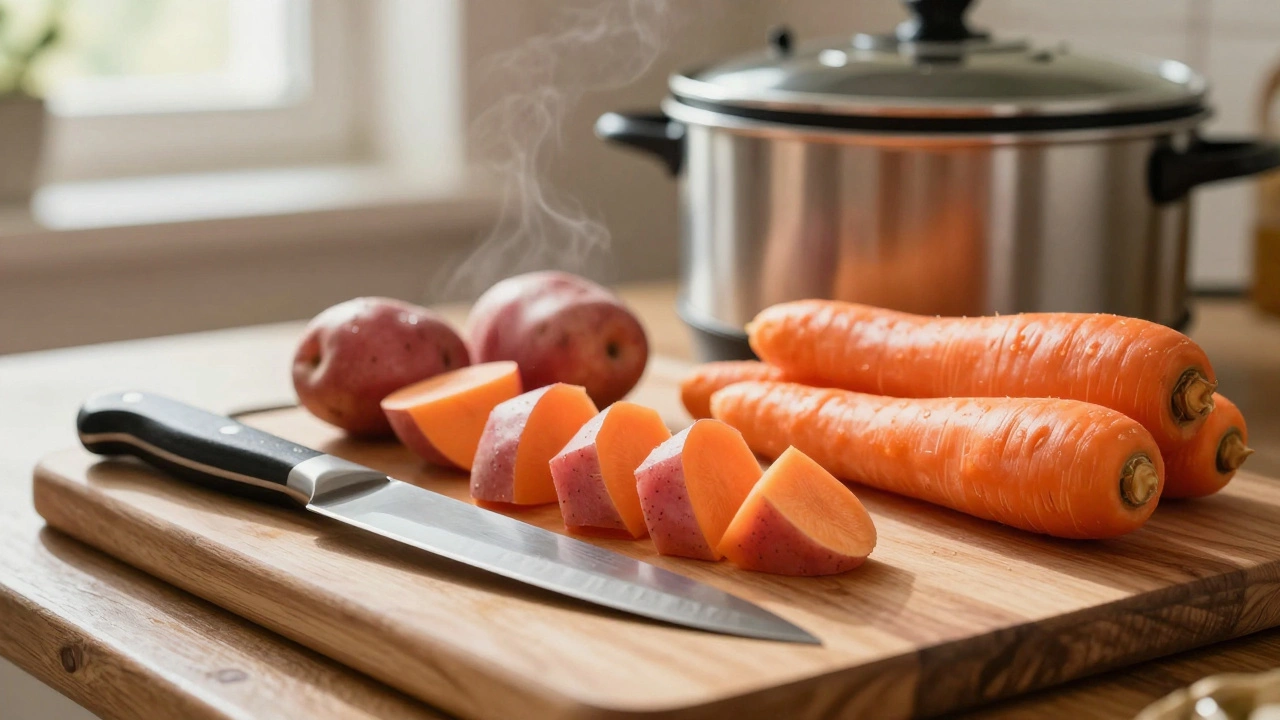
Slow Cooker Vegetable Timing Calculator
Cooking Parameters
There is nothing worse than opening your slow cooker after eight hours of anticipation, only to find a pot of meat swimming in a sea of mushy, disintegrated vegetables. You wanted tender carrots and firm potato chunks; you got puree. This common kitchen disaster happens because root vegetables behave differently in low-heat environments than they do on a stovetop or in an oven.
The short answer is that you should almost never put raw potatoes and carrots in at the very beginning of a long cook time. Instead, understanding the science of heat penetration and vegetable density will save your dinner. By adjusting when you add these ingredients, you keep their texture intact while ensuring they are perfectly cooked through.
The Science Behind Root Vegetables in Low Heat
To understand why timing matters, we have to look at how root vegetables are dense, starch-rich plants like potatoes, carrots, and parsnips that require significant energy to break down cell walls. Unlike leafy greens or delicate zucchini, which cook in minutes, roots are designed by nature to survive harsh conditions. They have thick skins and dense interiors packed with cellulose and starch.
In a conventional oven, high dry heat (usually above 180°C or 350°F) quickly penetrates the surface, caramelizing sugars and breaking down fibers from the outside in. A slow cooker is an electric countertop appliance that cooks food at low temperatures over a long period, typically between 70°C and 90°C (160°F - 195°F). Because the temperature is so much lower, the heat moves slowly into the center of the vegetable. If you leave a whole carrot or a large chunk of potato in there for six to eight hours, the outer layers eventually break down completely before the center is even fully tender. The result? Mush.
This is especially true if the vegetables are submerged in liquid. Boiling water breaks down starches faster than simmering broth does in a sealed environment. The key isn't just *when* you add them, but also *how* you prepare them.
The Golden Rule: Size Matters More Than Time
If you are determined to add potatoes and carrots at the start of your recipe, you must respect the size of the cuts. The general rule of thumb for slow cooking is uniformity. If your meat is cut into 2-inch cubes, your vegetables should be roughly the same size.
- Small Dice (1 cm / ½ inch): These can handle a full 6-8 hour cook on LOW. They will soften significantly but usually retain some shape if not stirred too aggressively.
- Medium Chunks (2-3 cm / 1-1.5 inches): These are risky for long cooks. They often turn mealy after 6 hours on LOW. Better suited for HIGH settings (3-4 hours) or added halfway through.
- Large Chunks or Whole Baby Vegetables: These hold up best for long durations, but even they may become overly soft if the liquid level is high.
However, relying solely on cutting techniques is a gamble. The most reliable method for perfect texture is staggered addition.
Method 1: The Halfway Addition (Best for Texture)
This is my preferred method for dishes like beef stew, chicken curry, or pork shoulder with veggies. The goal here is to give the meat enough time to become fork-tender without destroying the vegetables.
- Start with the Meat and Liquids: Place your protein, aromatics (onions, garlic), spices, and liquids in the slow cooker. Start the timer for the full duration (e.g., 8 hours on LOW).
- Calculate the Midpoint: For an 8-hour cook, the midpoint is 4 hours. For a 6-hour cook, it’s 3 hours.
- Add the Veggies: At the 3-4 hour mark, open the lid and add your peeled and chopped potatoes and carrots. Stir them gently into the liquid.
- Cook Until Done: Close the lid and let them cook for the remaining 3-4 hours.
Why does this work? By adding them later, you reduce their exposure time to the heat. Three to four hours is usually the sweet spot for root vegetables to become tender-crisp or fully soft without disintegrating. The vegetables also absorb the rich flavors developed by the meat during the first half of the cooking process.
Method 2: The Layering Technique (No Stirring Required)
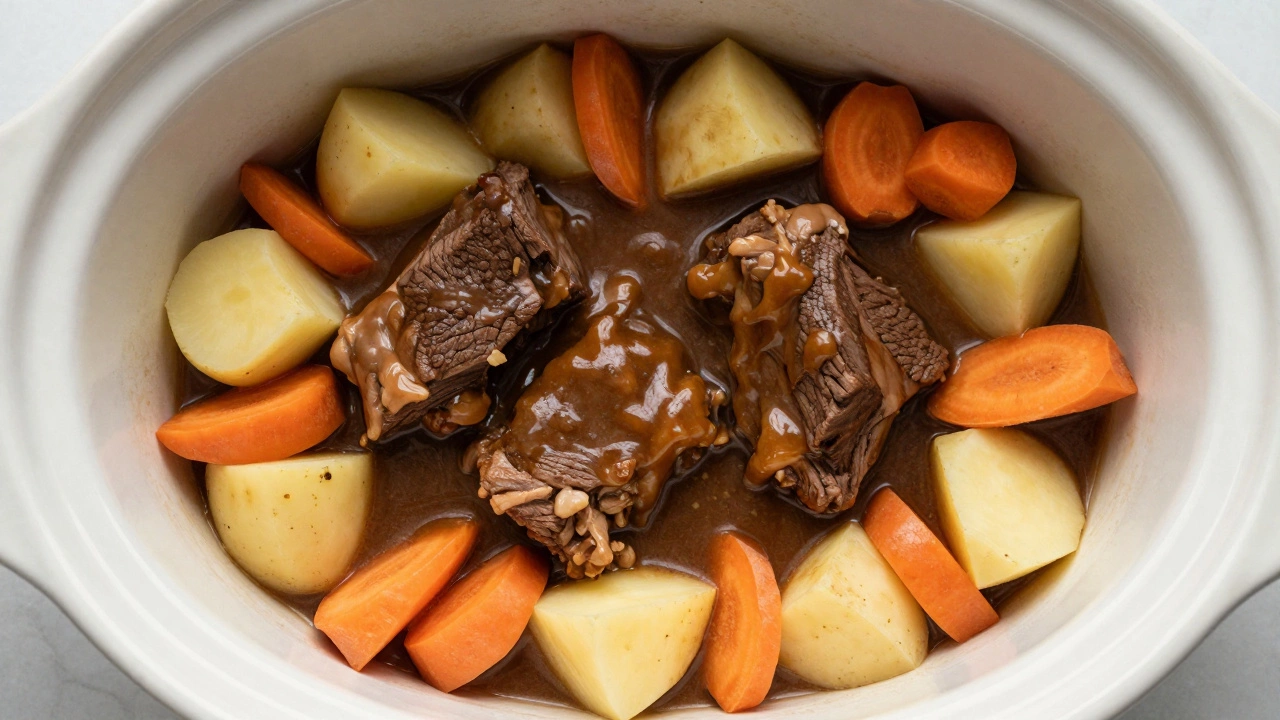
Sometimes you want to set it and forget it, but you still fear mush. The layering technique uses the physics of the slow cooker to protect the vegetables. In most oval or round slow cookers, the heating element is at the bottom. The center gets hot, but the edges near the glass wall stay cooler.
Here is how to execute this:
- Place Meat in the Center: Put your tougher cuts of meat directly on the heating plate in the middle of the pot.
- Surround with Veggies: Arrange larger chunks of potatoes and carrots around the perimeter of the pot, touching the glass sides.
- Pour Liquid Over Everything: Ensure the liquid covers the ingredients evenly.
Because the edges are cooler, the vegetables cook more slowly than the meat in the center. This method works best if you use slightly larger chunks of vegetables (about 3-4 cm). It prevents the veggies from sitting directly in the hottest zone of the pot for the entire duration.
Method 3: Parboiling for Precision
If you are making a dish where the sauce needs to be thick and creamy, like a potato leek soup or a hearty chowder, you might actually *want* the potatoes to break down. But if you want distinct pieces in a stew, parboiling gives you total control.
Boil your potatoes and carrots in salted water for 5-7 minutes before adding them to the slow cooker. This pre-cooks the exterior and starts the breakdown of the starches. When you add them to the slow cooker for the last 2-3 hours of cooking, they finish tenderizing quickly without needing prolonged exposure to the low heat. This method guarantees that your vegetables will never be undercooked, which is another risk with slow cookers-hard centers due to uneven heat distribution.
Special Considerations: Type of Potato and Carrot
Not all root vegetables are created equal. The variety you choose impacts how they hold up in the slow cooker.
| Vegetable Type | Starch Content | Texture in Slow Cooker | Best Use Case |
|---|---|---|---|
| Russet Potatoes are high-starch baking potatoes with fluffy flesh that breaks down easily. | High | Mushy, disintegrates | Soups, mashed potato toppings, thickening stews |
| Waxy Potatoes are low-starch varieties like Red Bliss or Yukon Gold that retain their shape when cooked. | Low | Firm, holds shape well | Stews, roasts, salads |
| Young/New Carrots are tender, thin-skinned carrots harvested early, requiring less cooking time. | Medium | Tender-crisp | Short cook times (3-4 hours) |
| Old/Mature Carrots are large, woody carrots with high fiber content that need longer cooking. | High Fiber | Can remain hard in center if cut large | Long cook times, purees |
If you are using Russet potatoes, treat them like a ticking clock. They will fall apart faster than waxy varieties like Yukon Gold or Red Potatoes. For stews where you want distinct chunks, always reach for waxy potatoes. For soups where you want a creamy base, Russets are your friend.
Similarly, old, woody carrots often have a hard core that refuses to soften even after hours of cooking. If you buy large, mature carrots, peel them thoroughly and cut them into smaller pieces, or consider peeling them partially to remove the tough inner stringiness. Younger, thinner carrots cook more evenly and are less likely to have a hard center.
Avoiding Common Pitfalls
Even with perfect timing, a few mistakes can ruin your vegetables. First, avoid overcrowding the pot. If you pack the slow cooker tight with meat and veggies, the heat cannot circulate properly. The vegetables in the center may stay raw while those on top steam excessively. Leave some room for air circulation.
Second, watch your liquid levels. While root vegetables need moisture to steam and braise, too much liquid can cause them to boil vigorously if you are on the HIGH setting. This accelerates the breakdown of cell walls. Aim for liquid that comes about halfway up the vegetables, not completely submerging them unless you are making a soup.
Third, resist the urge to stir frequently. Every time you lift the lid, you lose heat and extend the cooking time. Stirring also agitates the vegetables, causing softer ones to break apart prematurely. Give them space to cook undisturbed.
Adapting for Different Dishes
The timing strategy changes slightly depending on what else is in the pot. Here are three common scenarios:
Beef Stew
Beef chuck requires 8+ hours on LOW to become tender. Add potatoes and carrots at the 4-hour mark. Cut them into 2-inch chunks. Use waxy potatoes to ensure they don't disappear into the gravy.
Chicken Curry
Chicken thighs cook in 4-5 hours on LOW. If you add carrots at the start, they will be mush. Add carrots and potatoes at the 2-hour mark. Alternatively, parboil them for 5 minutes before adding to ensure they are cooked through by the time the chicken is done.
Pulled Pork
Pork shoulder takes 8-10 hours. You likely won't eat the vegetables with the pork immediately, or you might serve them on the side. Add carrots and potatoes at the 5-hour mark. They will absorb the smoky, savory juices and become incredibly flavorful.
Troubleshooting Your Results
If your vegetables turned out mushy, next time try cutting them larger or adding them later. If they were crunchy or undercooked, your slow cooker might run cool, or you added them too late. Some older models of slow cookers operate at lower temperatures than advertised. If this is a recurring issue, test your cooker with a thermometer. If it's running below 70°C (160°F), you may need to add vegetables earlier or switch to the HIGH setting for the last two hours.
Remember, slow cooking is as much about observation as it is about automation. Once you know how your specific appliance behaves and how different vegetable varieties react, you can master the art of the perfect slow-cooked meal. No more mush. Just tender, flavorful root vegetables every time.
Should I peel potatoes before putting them in the slow cooker?
It depends on the type of potato and your desired texture. For waxy potatoes like red bliss, leaving the skin on adds color and helps the potato hold its shape better. For starchy potatoes like Russets, peeling is recommended because the skins can become tough and chewy, while the inside turns mushy. Always scrub potatoes thoroughly if you decide to leave the skins on.
Can I freeze cooked slow cooker vegetables?
Yes, but the texture will change. Potatoes and carrots tend to become grainy or watery when frozen and thawed due to their high water content. If you plan to freeze leftovers, it is better to freeze the meat and sauce separately, then cook fresh vegetables when you reheat the meal. If you must freeze them together, expect a softer, less distinct texture upon reheating.
Why are my carrots still hard after 8 hours in the slow cooker?
This usually happens for two reasons. First, the carrots may have been cut too large, preventing heat from reaching the center. Second, your slow cooker may be running at a lower temperature than expected. To fix this, cut carrots into smaller, uniform pieces (about 1-inch chunks) and ensure they are submerged in liquid. If the problem persists, try parboiling them for 5 minutes before adding them to the pot.
Do I need to add more liquid when adding vegetables halfway through?
Generally, no. Slow cookers are designed to trap steam, so very little liquid evaporates. Adding vegetables halfway through does not significantly increase the need for liquid. However, if your dish looks dry or the vegetables are sticking to the bottom, you can add a small amount of broth or water (about ¼ cup) to prevent burning and help steam the vegetables.
What is the best way to thicken a slow cooker stew with potatoes?
If you want a thicker stew, use starchy potatoes like Russets and mash a few of them against the side of the pot before serving. The released starch will naturally thicken the gravy. Alternatively, remove half the potatoes and carrots before they fully cook, blend them with some of the cooking liquid, and stir the puree back into the pot. This creates a rich, creamy consistency without using flour or cornstarch.

Recent Posts
-
 Top Vegetarian Alternatives to Meat: What to Eat Instead March 7, 2025